
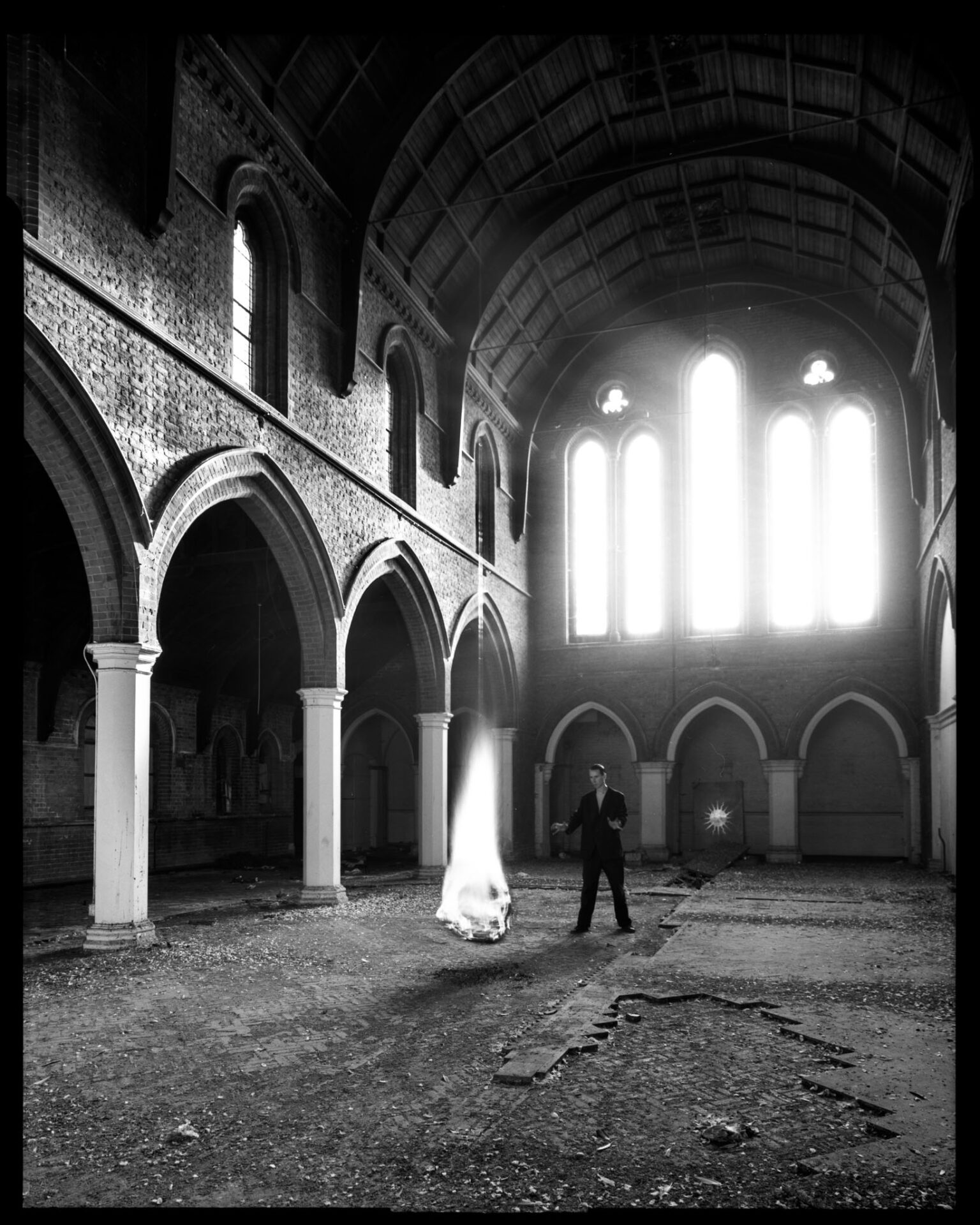
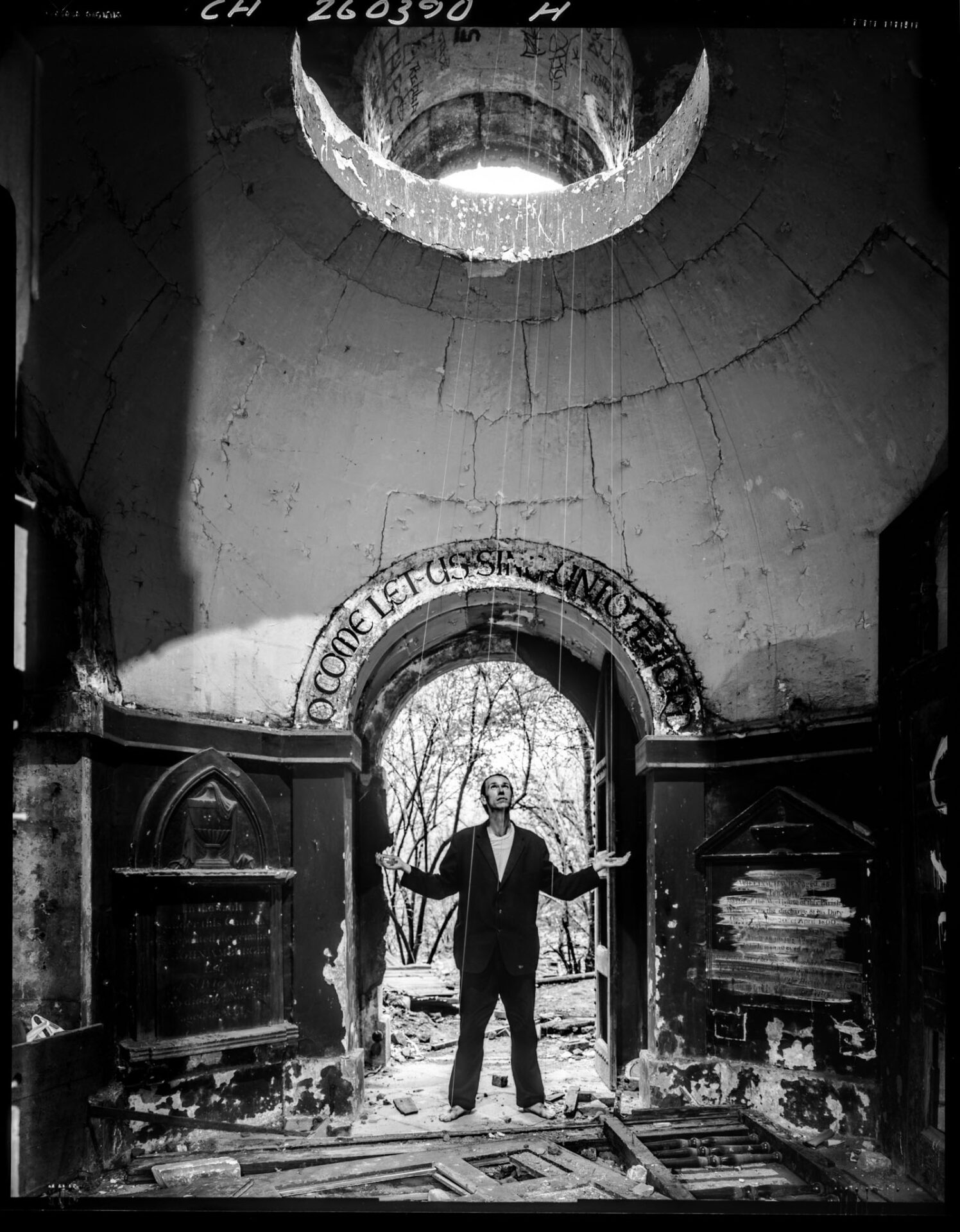
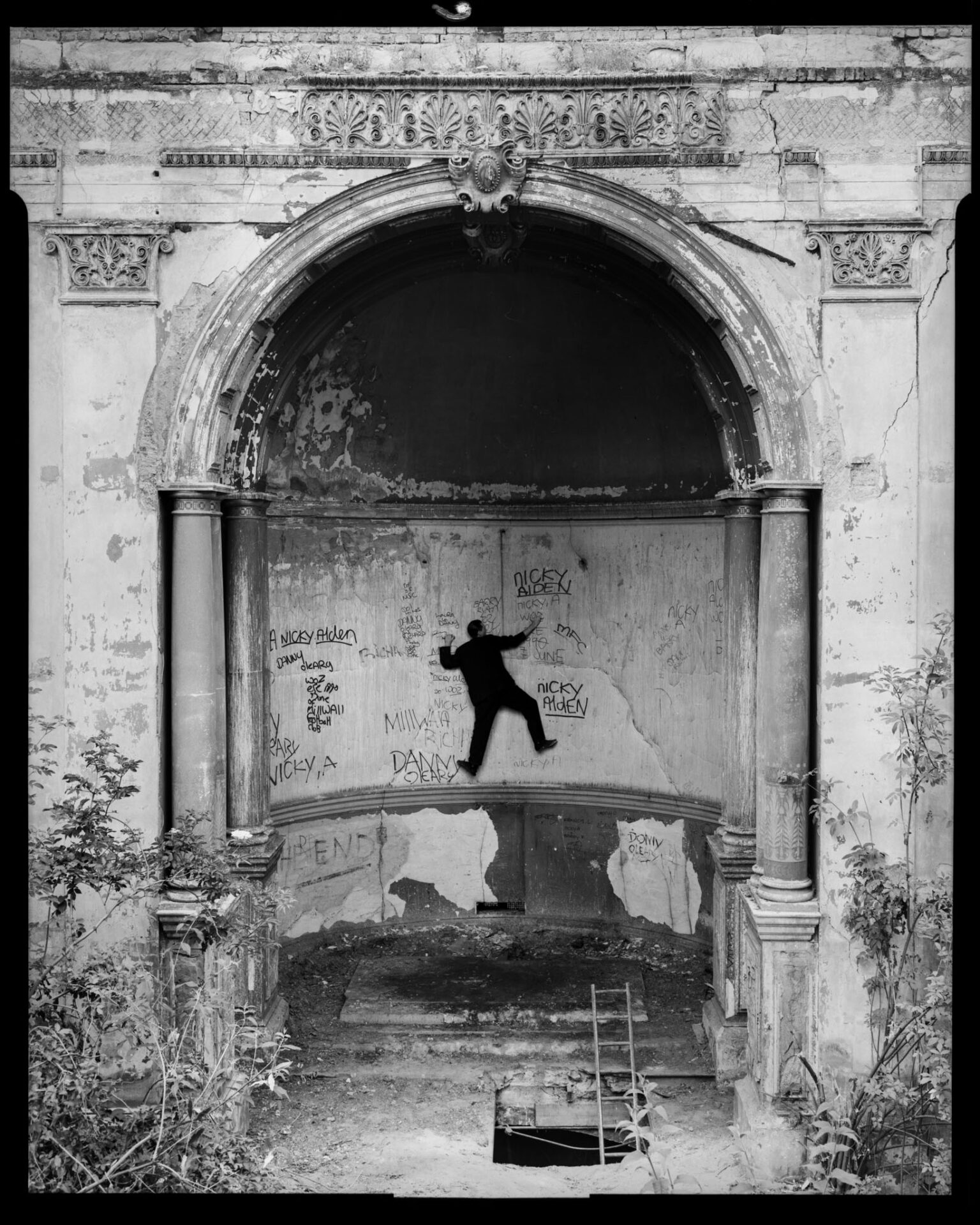
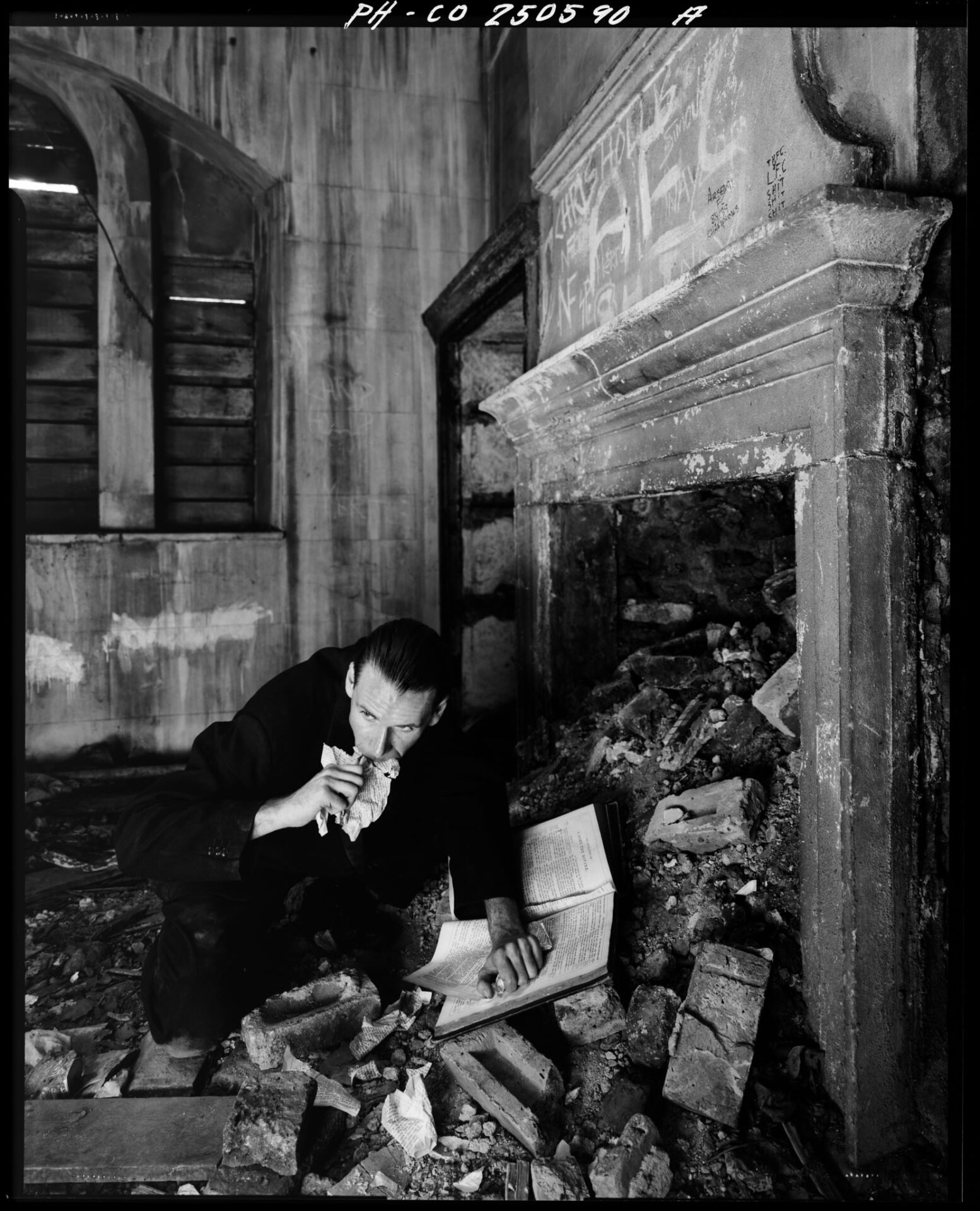
Thirty-five years ago, Chris Boot and I were commissioned by The Photographers’ Gallery to contribute a piece for their group show ‘The Invisible City’. With our model, Mark Linnington, we created a narrative tableaux of nine images. The leap of faith of one imaginary character, photographed in the remains of derelict London churches.
Shot on large format film using a Wista Field 45 camera, the photographs were exhibited as large prints, 1×1.3m, printed by Mike Spry at Downtown Darkoom.
Here are the images, framed by our original accompanying text from 1990.
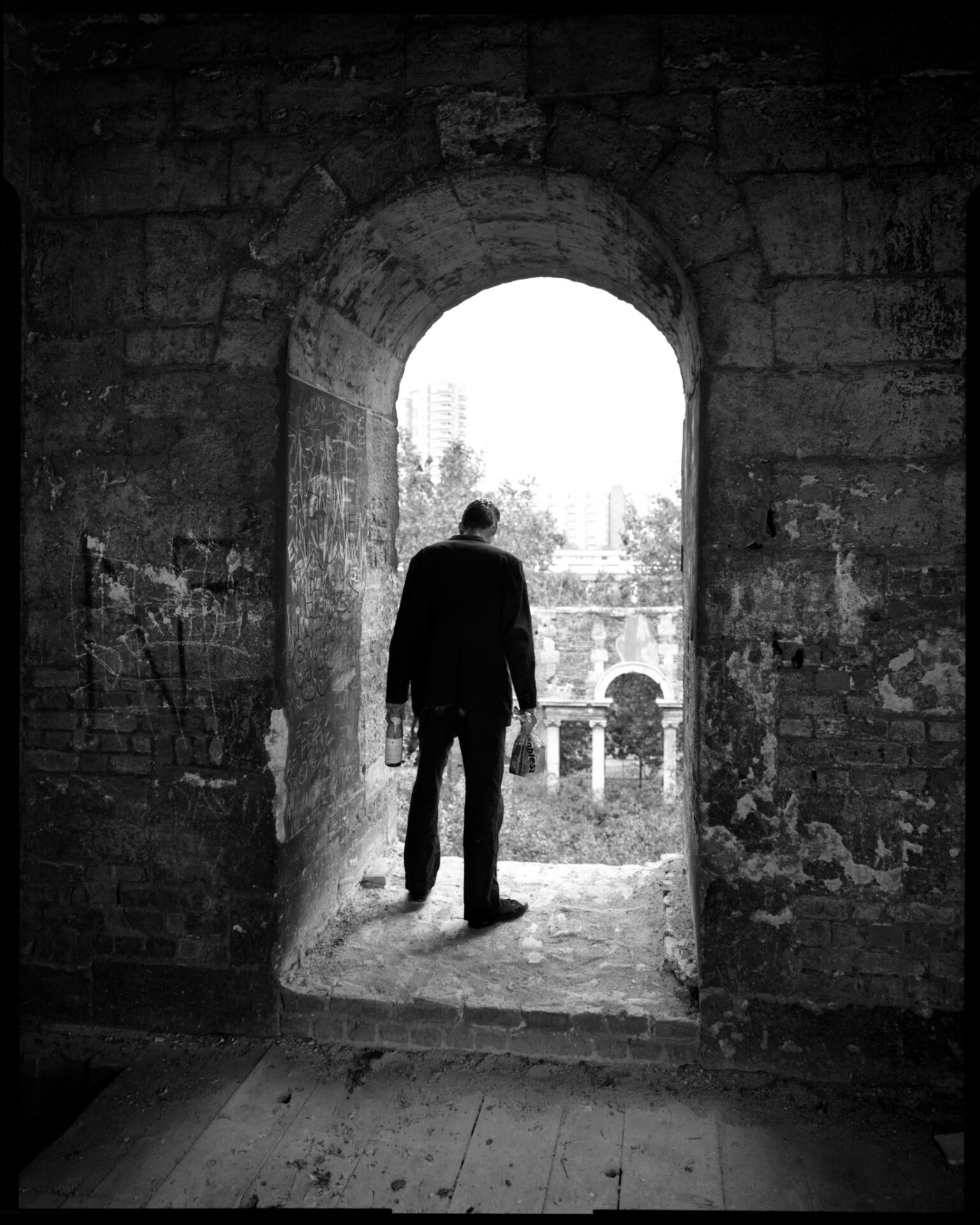
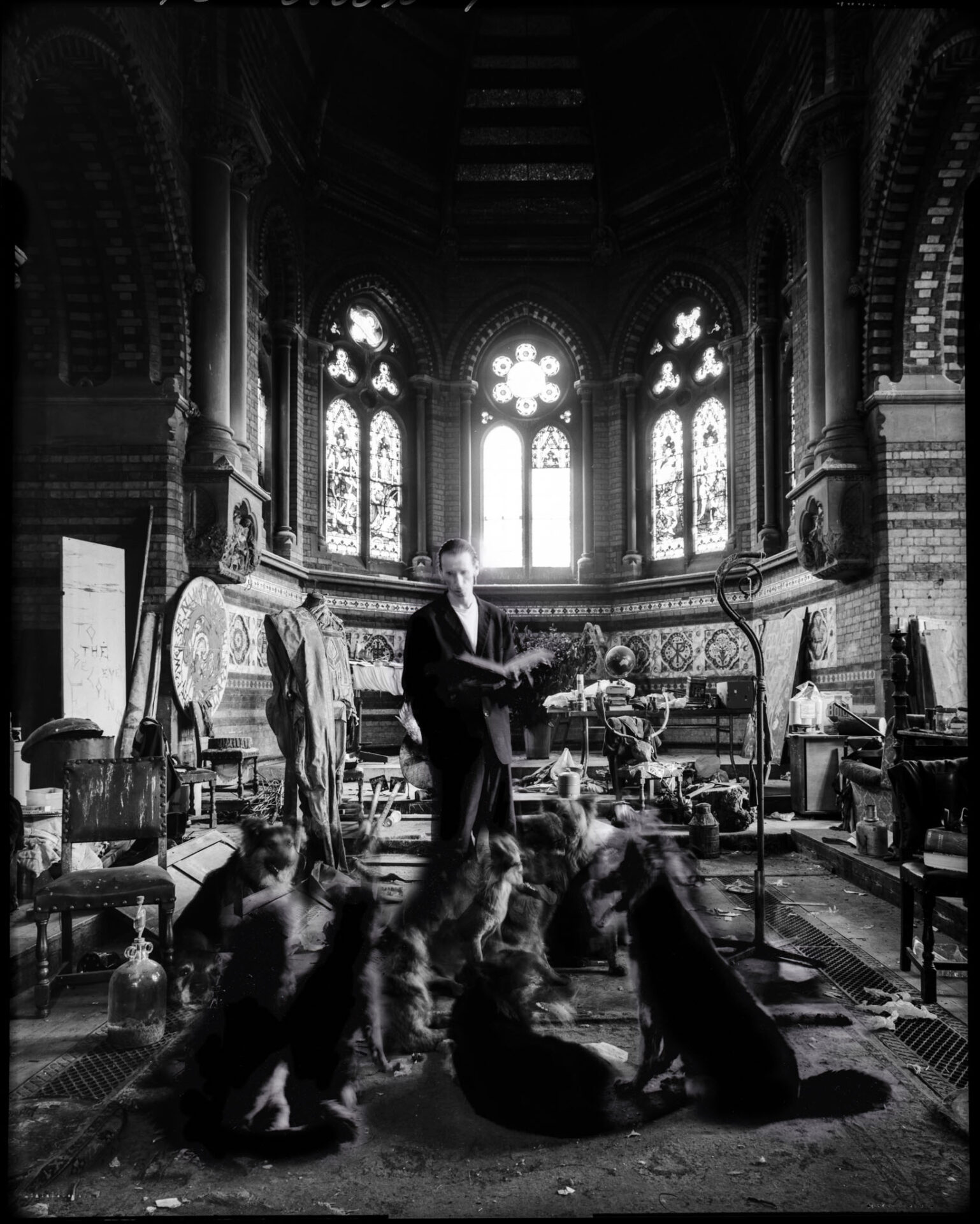
‘The first image is of a man in a church tower about to jump. Outside are the tower blocks of London. He clutches a bottle of wine and a loaf of bread, possibly his key to redemption in a positive act of faith, possibly his indifferent lunch and symbols of abjection as he hinges on the verge of suicide. We are never entirely sure whether he is destitute, imagining the possibility of redemption at the peak of his despair, or someone who experiences divine revelation in a manner typical of a Christian saint represented in an early renaissance fresco. The tableaux include this pilgrim/saint character devouring the bible, experiencing stigmata, preaching to a pack of dogs.
The narrative concludes in the plaster room of the V&A where, beneath a representation of St Francis’s deathbed scene carved onto a renaissance altar, the character lies apparently dead, with his broken wine bottle and bread scattered. Is this as a result of a fall from his lofty fantasy of saintliness? Or is he moving in, an object of religious art in a museum of faith?’



We do not make obeisance to the nature of wood, but we revere and do obeisance to Him who was crucified on the cross…When the two beams of the Cross are joined together I adore the figure because of Christ who on the Cross was crucified, but if the beams are separated, I throw them away and burn them.
Migne, Patrologia Graeca, 1384.
‘In London we are surrounded on the one hand by the evidence of the collapse of the Christian grand narrative, (literally manifested in ruined churches) and any singular idea of truth, and on the other by the multiplicity of opportunities for faith, spiritual and secular. In the consumer city we are presented with choices for individualized off-the-peg or made-to-measure belief systems and for various fundamentalist options.
It is in this context we find ourselves drawn to explore our own lack of faith and the possibility of belief, and our relationship to the church and its images. We are both attracted to Christian ritual and idiom as means of addressing and representing complex personal and cultural needs. We enjoy Christian rites as observers, participate in them as ecclesiastical tourists, appreciate the rhythms they mark in the day and the calendar – appreciating them, however, as culturally constructed. Without faith ourselves, we relate to them as if they were art, surface without truth, their meaning disembodied.
In the same way, we appreciate church art, images intended to have a specific spiritual function, as art – understanding it in relation to its function, but experiencing its function as theoretical rather than real. We visit a church the same way we visit a gallery.
In the way that a degree of spirituality is accorded all Art, whether religious or not, we ask what it is that makes an image capable of inspiring faith. The God of the old testament was distinguished from other gods by his unrepresentability and the old testament is a consistent polemic against the sanctification of images/idols. For Christians, Christ was himself a representation of God, and this becomes a theoretical loophole for those who have argued for the value of icons in worship: God can be depicted because he became material and took flesh, and if flesh became a vehicle of the spirit, then so could wood and paint.
With images which pretend spiritual value ‘Leap of Faith’ could be considered idolatrous; mischievous false idols which mock sainthood and the sacred Christian image. However, they are our own testament to the abiding power of images (representations and ideas) made to inspire faith. Though we reject belief in God, the photographs express an attraction to the idea of communal truth, and access to it via a leap of faith – our consciousness of the God-shaped-hole the death of God has left.’
Boot and Hughes 26/7/90
Leave a Reply